More or less “Naked Quatermass.” More or less

In 1982, cult film fave Tobe Hooper got his shot at the big time. He was already a major figure in the horror film world thanks to The Texas Chainsaw Massacre. He enjoyed mainstream success as the director of the original made for television Salem’s Lot, a movie that made a whole generation of children afraid to look out of their bedroom window. A year after Salem’s Lot, Hooper got a plum job directing a big-budget horror film to be produced by Steven Spielberg. Fans were excited to see what the king of survival horror could do with a Spielberg-size budget. Unfortunately, whatever it was he was going to do never quite came to be.
The stories about the creative differences between Hooper and Spielberg on the set of Poltergeist are the stuff of horror film legend, and the evidence of the finished product leaves no doubt as to who’s will prevailed. Depending on who you believe, Hooper either capitulated to Spielberg’s demands for a less horrific horror movie, or he was undercut by Spielberg who strong-armed Hooper out of the director’s chair when Hooper’s work proved too dark, or Hooper simply wasn’t up to the task of handling such a large budget and Spielberg had to step in and save everything. All that matters, ultimately, is that Poltergeist definitely feels like a Steven Spielberg film—which is not a bad thing. Spielberg’s output during this era was phenomenal, and Poltergeist was from the time when Spielberg would still melt faces and explode heads on screen.
Of course, there was some question as to what a Tobe Hooper film even looked like. Everyone identified him with The Texas Chainsaw Massacre, but it was unlikely he would have kept making that type of movie forever. Funhouse had its moments but flew under the radar and suffered a bit from being too obvious a Halloween cash-in. Still reeling from the Poltergeist experience, Hooper set out to show us what a proper Tobe Hooper horror film would look like, again with a decent budget and this time without the most powerful man in entertainment breathing down his neck. With money from the patron saints Golan and Globus at Cannon Films, Hooper packed up, headed off to London, where he began work on an adaptation of a book called The Space Vampires (at least you know what you’re getting) by Colin Wilson. The adaptation became Lifeforce.

Lifeforce is another one of those horror movies, like Alien and, later, Event Horizon, that wrapped itself in science fiction marketing. It’s also another one of those movies that lots of people seem to dislike but I predictably love—and not just because of Mathilda May, though there’s no arguing that she doesn’t hurt. It’s referred to by some as a rip-off of Hammer’s Five Million Years to Earth, aka Quatermass and the Pit, with a little bit of Night of the Living Dead thrown in, plus probably some Planet of the Vampires. And pretty much every movie that could was ripping off Alien at that point as well, so we might as well through that one onto the pile too, especially since Dan O’Bannon wrote the script for both it and Lifeforce (and Return of the Living Dead). Lifeforce does contain bits and pieces of all those films, but it mixes everything up into a completely loopy sci-fi horror tale featuring a perpetually nude lead and an exploding Patrick Stewart.
It’s 1984, and NASA has partnered with whatever organization it is that puts British people and their Harris Tweed spacesuits (I assume) in space for a joint mission to Haley’s Comet as it swoops by Earth and reminds us that Mark Twain has been dead since the last time the comet passed by. Like a lot of kids who grew up in the ’80s, I was enamored with space travel and assumed we’d be off this rock any day now, flying to Mars while listening to Enoch Light and drinking Tang cocktails. You have to remember, this was back when America still at least partially gave a damn about science or space travel or, well, doing anything other than watching deep-fried butter eating competitions. The world got into a Haley’s Comet frenzy in 1984, with a little bit of the “it’s a herald for the end of the world” insanity thrown in to keep things fun. No TV news commentator could agree on whether “Haley” was pronounced with a long or short “a,” but remember that this was also the era when American news anchors decided they were going to pronounce “harassment” as “HARE-ess-ment,” because someone somewhere heard a British person do that. Pity we didn’t also go in for “a-loo-minny-um.”
Then came the fateful day when the comet could be seen, and rather than being some giant, fiery smear across the sky, it was just a tiny dot. My disappointment was substantial, though considerably less than when our elementary school class had an all day “solar eclipse” party where we got to build our own solar ovens and cook hot dogs while watching the sun be blotted out entirely from the sky, causing people to go mad while the earth split open and spewed forth an army of dinosaurs. Only, it wasn’t that dramatic, you had to “watch” the eclipse via some shadow projector I think involved paper towel tubes lest you burn out your eyes, and cooking a hot dog in a shoebox covered with a-loo-minny-um foil takes like an hour, even on a sunny day.


Anyway, what starts out as a mere “scoop some space dust” research mission soon takes on a more complicated dimension when Colonel Tom Carlsen (Steve Railsback, Helter Skelter) and his crew detect a massive object in the comet’s tail. Further investigation reveals the object to be a space ship. Shortly after an expedition discovers human looking occupants in the ship, all contact between the shuttle crew and Earth is cut off. A month later, the shuttle returns to earth. The crew is dead, and Carlsen is missing, but the bodies—two stark naked men and one stark naked woman (guess which of the three gets the most screen time)—recovered from the alien spaceship are perfectly preserved. They’re transferred to a research facility where, through the magic of flashing blue lightning and a wind machine (I guess Hooper had at least something he liked about Poltergeist), the aliens are revived and start sucking the life out of any human on whom they can get their hands.
Eventually, Carlsen falls back to Earth in an escape pod, and the whole grisly story of what happened on the shuttle is revealed. Carlsen, as obsessed with protecting the female alien (Mathilda May, who has to be the very final word in otherworldly allure) as he is with destroying her, teams up with British SAS officer Colin Caine (Peter Firth) to track down the three “space vampires,” who are leaving a trail of corpses in their wake as they suck youth and health from humans and manage to emit a weird hypnotic aura that is slowly infecting London with a zombie-like madness that does indeed feel like something straight out of a Quatermass story, albeit a naked-er version of Quatermass than the ones we got. Along the way, they interact with a number of characters who seem so perfunctory to the plot that I can’t even remember what it was they were doing. But one of them is Patrick Stewart, and his face explodes.
There are plenty of parents who would argue against the idea that Poltergeist was a family-friendly horror film, what with the maggot meat, face ripping, corpses exploding from the ground, and Zelda Rubenstein. And I’d say those parents have a point, though mine were cool with me seeing it when I was ten. Tobe Hooper, however, must have wanted to go in the opposite direction, so he packs Lifeforce with an immeasurable amount of full frontal female nudity and exploding Patrick Stewarts, something for which we kids were even more thankful for than the face ripping scene in Poltergeist.
I’m not a parent and have no interest in being one, but it probably allows whatever pushy “family values” activist group that does such things to breathe a sigh of relief that there isn’t me out there with a young child going, “What? Why wouldn’t I let my kid watch John Carpenter’s The Thing?” On the other hand, maybe I would forbid them from watching sexy, gory, awesome movies simply so they know the joy of sneaking around and watching those movies anyway. It’s a low-impact rebellion, and you learn valuable skills. I’m sure that part of the reason I have any sort of technical know-how these days stems from learning to program a VCR when I was in the sixth grade so I could clandestinely tape Barbarian Queen.

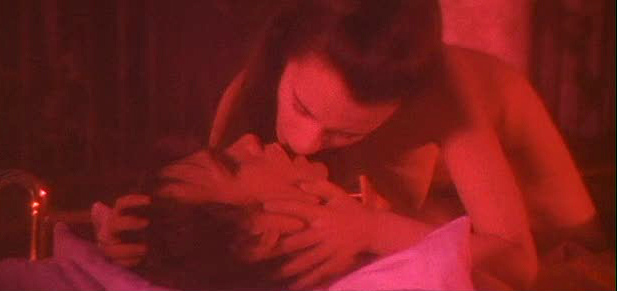
Mathilda May’s vampire is supposed to be strange and ethereal, and her acting is suitably hypnotic. It is absolutely understandable how Colonel Carlsen comes to be in her thrall. Beyond this movie, I know almost nothing of her career other than, predictably, the movie The Tit and the Moon, which is mostly about a little boy who becomes obsessed with Mathilda May’s naked breasts. Oh yeah she was in the lukewarm Bruce Willis espionage film The Jackal. The two male vampires have no character whatsoever, and as willing as Hooper is to flaunt May’s body, he doesn’t do the same for his two vapid male ghouls. Full frontal male makes a token appearance from time to time, but there’s definitely no equality.
Peter Firth as Colin Caine (not to be confused with Colin Firth as Peter Caine) goes through the movie looking like he just bit into a lemon right as someone told him his unmarried teenage daughter was pregnant. The entire “space vampires sucking the life out of people and turning London into a massive pit of crazed zombies and flashy blue lights” phenomenon seems more to irritate him than terrify him, like he’s a sullen ten-year-old boy and this horrible apocalypse is an aunt trying to give him a kiss. He’s lovably weary of the whole ordeal (which makes him a bit like Quatermass often was), and he looks cool in his turtleneck and leather jacket.
Steve Railsback just sort of “is” in this movie. He’s not bad, and it’s not that he isn’t trying, but his character is supposed to be perpetually out of it and confused. It doesn’t make for a sparkling turn, and he’s lucky to be paired with Firth’s vast collection of sneers and sourpuss faces. The rest of the cast is, well, most of them are British, and no matter what crap you give them to perform, British actors go about it with able competence. They are all veterans, and it’s fun to see critically lauded legends like Frank Finlay having a go at such outlandish material but totally giving it their all. Respectable Brits will constantly appear in the most godawful flms but still handle the part professionally. Frank Finlay here, for example, or the entirety of Britain’s collection of honored stage actors in Caligula.


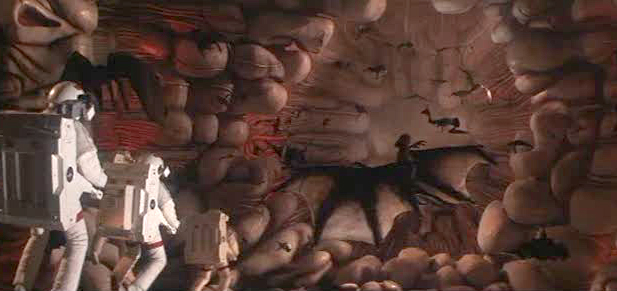
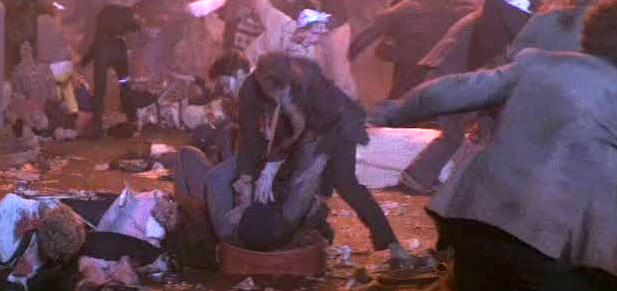
Hooper’s direction is good, and the special effects make it obvious that, his movie or not, he learned a good deal from Spielberg and Poltergeist. There’s a lot of blue lights shooting all over the place. Some of the sets are pretty great, too. The vast interior of the vampires’ spaceship is wonderful, ridiculous visual joke that it may be: a long reddish-pink tunnel down which float a group of white-clad “astronauts.” I guess Dan O’Bannon didn’t exorcise all his vagina dentata demons with Alien. But the real star effect has to be the sprawling scenes of London in flames, hearkening back to the finale of Quatermass and the Pit. Hooper pulls off a truly city-wide apocalyptic feel on a fraction of the budget possessed by directors like Spielberg. Golan and Globus productions are known for a lot of things, but looking expensive is not one of them (that was Dino de Laurentiis’ trick). So the best compliment I can pay to Lifeforce is that it doesn’t look like a Cannon film. It played in movie theaters, and it looks like it belongs in movie theaters (even if it performed poorly in them).
This is partly thanks to Hooper’s fleet-footedness as a director, and partly thanks to cinematographer Alan Hume. Hume worked on Hammer films, about eight thousand “Carry On…” films, The Avengers television series, Return of the Jedi , and three James Bond films (For Your Eyes Only, Octopussy, and A View to a Kill). He even had ample experience trying to make something epic on a minuscule budget, having worked with director Kevin Connor on the many low-budget adventure films he made at Amicus during its final days. This was a man with a good eye, and he makes this Cannon Film oddity look great.
Much of this film’s crew is composed of “how the hell did they get him” workers. For instance, the music is by Henry Mancini. Really? How the hell did Cannon snag him? I mean, I was watching a ridiculous SyFy Channel movie the other day that had music by Lalo Schifrin, and I wondered how the hell they got him—until I saw that the director was named Ryan Schifrin. But how did Cannon secure the services of Henry Mancini for a naked space lade horror movie? And furthermore, why would you hire Henry Mancini then, in the theatrical cut of the film, replace most of his music?


Effects wizard John Dykstra is another heavyweight helping lend this film a look far beyond what one expects from Cannon. Dykstra was coming off a stint that included Star Trek: The Motion Picture, Battlestar Galactica, and Star Wars He does a pretty great job. Working with Dykstra and Hume to make this look like a real movie was production designer John Graysmark, who worked on movies like Lawrence of Arabia and 2001: A Space Odyssey. Lifeforce boasts some really impressive miniature work. The animatronic and puppeteer driven corpses that pop up here and there aren’t “realistic” per se, but they do look appropriately zombie-ish and look a lot like the effects on screenwriter Dan O’Bannon’s directorial project from the same year, Return of the Living Dead. You could basically swap them out for each other and be none the wiser. Wait. Is this a cinematic universe??
O’Bannon, his script here is generally good if at times convoluted. He keeps things moving along, and there are bits of wit and black humor, but it’s not in the same league as Alien or Return of the Living Dead. Lifeforce often slips into sloppiness in the rush to put more weird shit up on screen, which at least is a relatable crime. Chief among the offenses is how the powers possessed by the vampires seem to change whenever the plot needs them to. They can mind control, but they can’t apparently mind control everyone (Peter Firth just wades through all the carnage without ever once letting space vampire mind tricks remove his desire to make annoyed faces). Mathilda May can apparently not just do mind control, but can actually take over someone’s body if she needs to and cause Patrick Stewart to vomit up her bloody apparition. I also like the scene where they slap Patrick Stewart around to get him out from under the space girl’s spell, and when he finally awakens as himself, they yell at him to let them speak to her inside him. Stewart really takes a beating in this one. In fact, much of the dialogue is risible. “She’s looking for a man. Any man. A healthy man.” Luckily, no matter how bad O’Bannon’s words may be, the stolid British cast delivers with all the solemn gravitas of the greatest dialogue ever written.
However, one thing O’Bannon does well is make the vampires, naked or not, seem like a substantial threat. Their ghoulishness starts out small, but it gets bigger and bigger and you really start to believe that they are a major threat to humanity (always a trick with a human-sized monster). And maybe the flexible nature of their power contributes to this. No one really has any idea exactly what the vampires can do or what it is they want. It helps sell the desperation, and ultimately the mass destruction, of the situation and create tension during the finale.

Lifeforce was the point to which Cannon had always been building. All those cheap action films, all those ninja movies, it was all building up the war chest to make a movie as large-scale and “big” budget as this. This was Cannon’s tentpole picture, the one that would legitimize them. Unfortunately for Hooper and Cannon, Lifeforce was a financial dud. Critics panned it, and people who went to see it mostly thought they were going to see a Star Wars-y space adventure, not a movie packed with nudity, gore, and zombies. Even Hooper fans, keen to see what he could do without all the “let’s hug!” family aspects of Poltergeist, didn’t embrace the movie, finding it either too polished or just too weird. Mostly, as was and continues to be his curse, they found it “not anything like The Texas Chainsaw Massacre.”
The film was trimmed against Hooper’s wishes from 116 minutes (itself down from Hooper’s original 128 minutes) to 101 minutes. At the box office, it lost out to another sci-fi film with a lot of blue lighty stuff in it, Cocoon, which didn’t feature full frontal nude space girls but did feature topless Wilford Brimley and at least a little fan service for the kids, in the form of Tahnee Welch’s naked bum. Lifeforce did find new life on cable TV, which is where I saw it, but even then it never developed more than a small—if weirdly dedicated—cult following, of which I am proudly a member.
Lifeforce made around half of its estimated $25 million budget, which is maybe why Cannon never gave a movie this big a budget again. It’s often mostly as the film that destroyed Cannon—the Cleopatra of Cannon, if you will. Though the studio survived for several more years, they never recovered from the financial disaster caused by Lifeforce. Hooper managed a couple more directing jobs as part of his deal with Cannon, including a pretty good remake of Invaders from Mars, and The Texas Chainsaw Massacre 2 which…well…if fans were mad Lifeforce wasn’t enough like Texas Chainsaw Massacre, then TCM2 really threw them for a loop. After that, he was relegated to the ranks of for-hire TV directors, emerging occasionally to get horror fans’ hopes up by directing a new feature film, then inevitably disappointing them.
Kind of a shame. I don’t think Hooper is a bad director at all. He’s directed some bad films, but those have been bad on levels other than the direction most of the time, so it’s not fair to saddle him with the blame, just as it’s not fair to expect everything he does to be as stripped down and visceral as The Texas Chainsaw Massacre, a film that could only be made once (as the sequels prove). And at the end of the day, I’d rather watch Lifeforce. Yes, it lacks the stark, survivalist terror of Hooper’s debut, but it’s also much more entertaining. I don’t like it just because I like that Hooper was “trying something different.” I like it because I like it. I watch it at least once a year and like it more every time. It’s weird, with a creepy, decadent atmosphere and a spirited cast of British stalwarts anchored by Peter Firth making “I just stepped in poo” faces throughout the whole thing.
 Teleport City