Diving into the world of James Bond cash-in albums
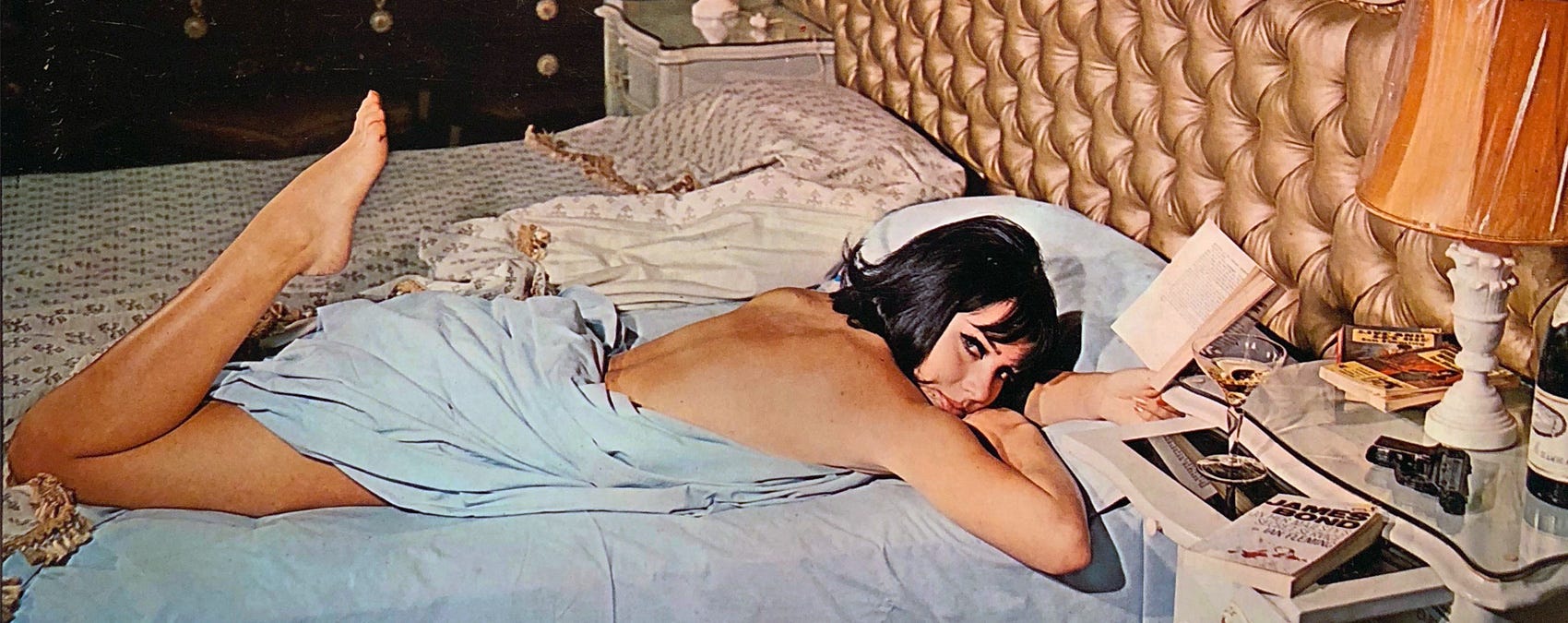
There are many elements that go into making and so have become defining factors of James Bond films: the clothes, the cars, the exotic locations, the drinks, the attitude—and of course, the music. James Bond without John Barry and Monty Norman’s instantly identifiable guitar and big brass theme might as well be that guy from Agent for H.A.R.M. John Barry’s work on the Bond films created the audio template in which all future Bond composers would operate. Even the ones who synth and disco’d things up in the 1970s and ’80s still colored within the lines of Barry’s style. As Never Say Never Again illustrated, James Bond without the James Bond sound was awkward. When the Bond films proved runaway successes in the 1960s, hundreds of movies were made in dozens of countries, all looking to cash in on the same basic formula, and each of those movies needed music. What they came up with, often composed by exceptionally talented and creative artists, was usually breezy, swinging ’60s-style cocktail lounge music laced with the occasional twangy guitar. Outside of film scores, there was an equally lucrative cash-in industry of record labels releasing Bond and spy-themed albums not connected to any actual movie—at least not officially.
Most of these albums were disposably enjoyable, offering nondescript but professionally competent renditions of popular Bond theme songs, as well as music from assorted espionage television shows. Some also mixed in original compositions done in the style of Bond music, and more than a few threw a half-assed rendition of a Bond theme song onto an album full of otherwise unrelated-to-spy-stuff easy listening tunes so they could justify calling the album Music to Thrill By or something and putting a picture of a guy with a Walther PPK on the cover.
There were a number of pretty great cash-in albums and cash-in composers sprinkled through the trend, the biggest of whom happens to have also gotten the closest to actually working on a James Bond film…even if it was 1967’s Casino Royale.
Roland Shaw: The Man with the Golden Horn
Towering above all other Bond cash-in album composers was Britain’s Roland Shaw, an accomplished musician who attended the Trinity College of Music and served in the Royal Air Force in World War II, where he lead the RAF No. 1 Band of the Middle East Forces. Shaw released a series of James Bond cash-in records that featured arrangements of 007 themes and background music that were often just as good as the originals, and in some cases, perhaps even better. His willingness to delve into the library of background music is what set Shaw apart from his contemporaries, most of whom were happy to simply churn out a thousand different covers of the themes from Goldfinger and Thunderball.
Recording for Decca between 1966 and 1971, Shaw and his orchestra released several James Bond-themed albums, as well as one album of more general spy themes. Keeping the albums straight can be a chore, as in the true spirit of cash-in albums, they were re-released multiple times, often with different names and covers. Plus, Shaw’s previous releases were frequently reassembled by producers into wholly different albums. But the following run-down should cover the additions you need to make to your smooth spy lounge soundtrack.


Themes From The James Bond Thrillers (1964)
Shaw’s first foray into the world of all-007 music sets the tone for all of Shaw’s subsequent albums. It’s a mix of main themes (From Russia with Love, Goldfinger, and the James Bond Theme and other notable cues from From Russia with Love, Goldfinger, and Dr. No. Most of the best songs on this collection would pop up on later Roland Shaw albums, but a couple — “Dr. No’s Fantasy” (from Dr. No), “Leila Dances,” and “The Golden Horn” (both from From Russia with Love) — I haven’t found on any other album but this one. Shaw’s arrangement of “007” is, in my opinion, even better than the John Barry original.
More Themes From James Bond Thrillers (1965)
Shaw’s follow-up to his first album of Bond music is another great one, partly because it sticks almost entirely to more obscure tracks and background music. There’s the obligatory arrangement of the theme from the latest Bond movie (Thunderball, with no one bothering to attempt a recreation of Tom Jones’ vocal bravado), but after that, Shaw shies away from themes and instead serves up great takes on the rest of what James Bond music has to offer: a few tracks from Dr. No (including a cover of “Underneath the Mango Tree” that has the first appearance of vocals on a Roland Shaw spy music album), From Russia with Love, and Goldfinger. There’s not as much that’s as “iconic” on this album, though once again it’s very good and serves to create a more complete universe of James Bond music.
Themes From The James Bond Thrillers, Vol. 03 (1966)
This third volume of Bond music kicks off with a vocal version of the theme from You Only Live Twice. While I wouldn’t go so far as to say this version is superior to the Nancy Sinatra original, it’s still an great version. The rest of it is pretty good as well, once again leaning heavily on music other than the themes — though you do get arrangements of the themes from 1967’s Casino Royale (both the Herp Alpert song and Dusty Springfield’s “The Look of Love” with vocals that obviously can’t match Dusty) and Thunderball, just in case you didn’t have enough versions of the theme from Thunderball. The rest of the tracks are cues taken from Thunderball, You Only Live Twice, Casino Royale, From Russia with Love, and one more from Dr. No. All good stuff, but the theme from You Only Live Twice makes this one essential.


Themes for Secret Agents (1966)
This collection of brassy, bombastic themes ranges outside the James Bond canon and includes arrangements of music from The Man from UNCLE, The Saint, The Spy Who Came In from the Cold, Our Man Flint, I Spy, The Avengers, and The IPCRESS File. There are still several Bond themes, including “Mr. Kiss Kiss Bang Bang” and the themes from Goldfinger, From Russia with Love, Thunderball, and of course the James Bond theme. Shaw keeps things fast paced and upbeat. In particular, I love his versions of The Avengers theme, From Russia with Love, and “The James Bond Theme”—that last one will make you feel like going out and getting in a speed boat chase or leaping from rooftop to rooftop in pursuit of some dastardly assassin.
The Return Of James Bond In Diamonds Are Forever…And Other Secret Agent Themes (1971)
This is a spectacular sampler of Roland’s work, sticking primarily to main themes rather than highlighting lesser-covered tracks. Released in 1971, it repackages many of Shaw’s arrangements of the Bond themes and combines them with other spy movie and TV themes featured on other albums. New for this album are superb renditions of the themes from Diamonds are Forever and On Her Majesty’s Secret Service, as well as the song “Let the Love Come Through,” which Shaw originally wrote for the 1967 James Bond send-up, Casino Royale. Those three tracks make this album worth the repeated material, but you also get Mission: Impossible, Peter Gunn, and Wednesday’s Child. The orchestra’s “Diamonds are Forever Reprise” decides that nothing jazzes up a song quite like adding a bunch of funky wah-wah guitars.
And They Strike!
There were a lot of other great albums made to cash in on the popularity of music from the James Bond movies. There were even more passable but forgettable albums, and more than one or two terrible ones. And then there were a few that were, for one reason or another, completely weird. A lot of the people working in the field of cash-in albums were legitimately talented musicians, so the urge to tweak the formula and get a little bonkers must have been overwhelming.
While by no means the “weirdest,” here are some of my favorite variations on the spy lounge theme.

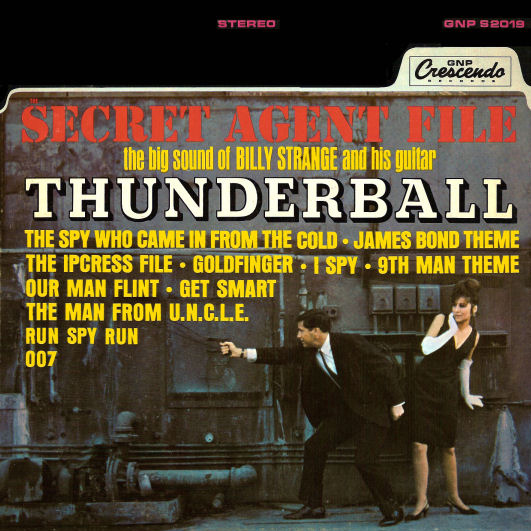
Billy Strange
The Secret Agent File (1965)
James Bond Double Feature (1967)
Billy Strange was, among other things, a guitarist for the famed collection of studio musicians that became known as the Wrecking Crew. If you’ve never heard about them, I suggest you do a bit of reading, because the story is fascinating, and a sobering look at how the music industry works (in short: many of the greatest groups in music history played their own instruments a lot less on albums than they’d like you to know). In addition, Strange worked with Lee Hazlewood and Nancy Sinatra, and arranged the non-soundtrack version of Nancy’s You Only Live Twice theme, which adds a pretty amazing layer of bombast to the song. He’s also the guy playing guitar on her melancholy hit, “Bang Bang (My Baby Shot Me Down)” and did the arrangements for “These Boots Are Made for Walkin’.” He’s the guy playing guitar on the theme from the TV shows The Munsters and Batman. He worked with everyone from Elvis Presley to the Beach Boys to Willie Nelson. So…by no means is he some fly-by-night musician. Strange was the real deal.
Obviously, a Strange album of James Bond music is going to lean heavily into the guitar. The first of two Bond cash-ins for him, The Secret Agent File starts with a banger of a version of the Thunderball theme (the movie was released the same year as this album), full of twanging surf guitar and macho brass. That’s followed by a moody rendition of “A Man Alone,” the theme from the stellar Michael Caine spy film, The IPCRESS File.
Strange delivers most of the hits you will come to expect from a James Bond-inspired album, including great versions of I Spy, The Man from UNCLE, Get Smart, Our Man Flint, and a moody arrangement of the theme from the bleak The Spy Who Came In from the Cold, based on the grim John Le Carre novel. There are also top-notch versions of the James Bond theme; the nigh-ubiquitous “007 Theme” that manages to stand out from the pack and is very Ventures-esque (which makes sense—Strange worked with the Ventures) and then figures what the hell, why not throw in some burlesque beat R&B sax; and the similarly ubiquitous Goldfinger theme.
Strange’s second foray into spy movie music, James Bond Double Feature, is more varied, both in content and style. While it’s unfortunate that we don’t get his version of You Only Live Twice with Nancy (you can find that on the Nancy Sinatra retrospective Lightning’s Girl: Greatest Hits 1965-1971), we do get quite a lot, though not a lot of James Bond. The album fulfills the letter of the title, if not the spirit, and presents two Bond theme covers, one for You Only Live Twice and the other for Casino Royale, both released the same year as this album. Both are quite good.
The rest of the album is also good, despite the lack of any more 007 music. Strange shows his mastery of a number of styles, turning in everything from Ennio Morricone numbers (the theme from For a Few Dollars More) to breezy lounge pop (The Summer Scene, the theme from Alfie), and a pretty great version of the theme from In Like Flint. So, while it may be light in the James Bond music department, this is still a good album to pick up, especially if you’re a fan of twangy surf-meets-spaghetti western guitar.


Cheltenham Orchestra & Chorus
Songs from Goldfinger (1964)
If you have at least a passing familiarity with cocktail lounge music, you’ve probably run across the New Classic Singers and their version of “Call Me.” Even if you don’t know them, you know the sound, because it’s the very typical lounge sound you’d think of: lots of strings, and a chorus hitting you with lots of “zu zu zu wow!” singing. If you can imagine that sort of lounge pop choral group doing Bond themes, then you can begin to grasp this record. Four songs aren’t really enough, but then again, maybe it is, because at just four tracks, it manages to be entertaining and even charming without the novelty wearing thin. Three of the songs are Bond themes: From Russia With Love, Goldfinger, and the “James Bond Theme,” which is a pretty small offering of Goldfinger songs for an album called Songs from Goldfinger. The fourth is a track with the rolls-off-the-tongue title of “Theme For Guitar – Fran – Chucks Monster – Riff – Funky.” It’s a little…you don’t want to call this sort of bubblegum cocktail pop “edgy,” but let’s just say it eschews the soothing singers in favor of electric guitars, wild drums, and a sax player who apparently wandered in from a 1960s burlesque club.
David Lloyd & His London Orchestra
Confidential: Sounds For A Secret Agent (1965)
The thing that makes this album weird isn’t the arrangement or style of the music. It’s pretty straightforward cocktail stuff. No, it’s the fact that almost all of these “themes” are original pieces. You should be clued in almost immediately by the fact that the album features themes based on Bond stories that wouldn’t be made into movies for years yet. So what you have, then, are original themes written by David Lloyd for the Ian Fleming books, though a few movie themes make it in. Just in case you didn’t already have 10,000 versions of Goldfinger, you get another one here, and it’s pretty good. Also, you probably needed one more version of “007” from From Russia With Love, so here you go. Lloyd’s arrangement of the From Russia With Love theme is nice, with a lot of strings and even an accordion because, well, why the hell not? It’s like a version you’d hear by a band of talented French musicians pestering you outside a cafe while you’re waiting to exchange microfilm with a beautiful Eastern European spy. After those selections, and the obligatory “James Bond Theme,” you get into the original stuff. While I can’t say any of it is overly memorable, it’s all decent, and if nothing else, it’s fun to hear what Lloyd imagined as the theme songs and then compare it to what became the theme song for the eventual movie. John Barry’s job was never in jeopardy, but I like most of Lloyd’s concepts.
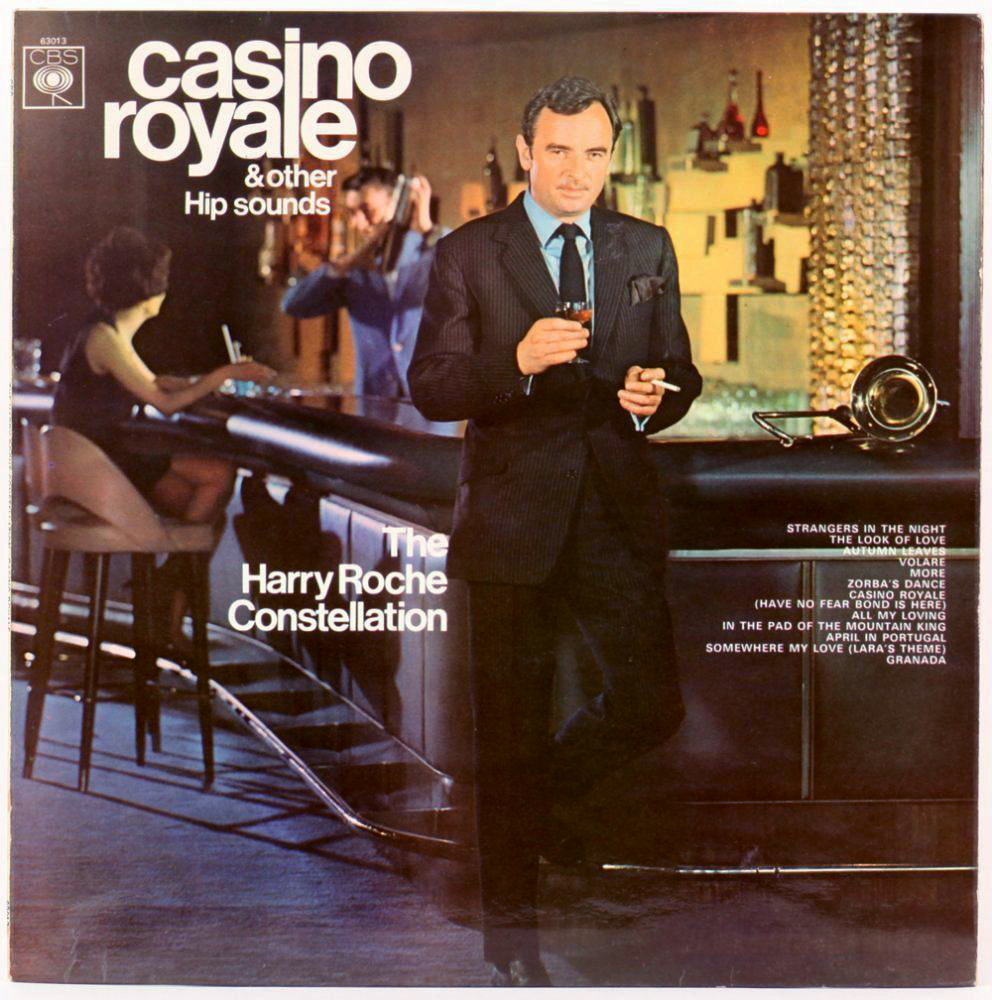

Harry Roche Constellation
Casino Royale & Other Hip Sounds (1967)
First of all, the fact that they refer to their songs as “hip,” even when it was hip to call things hip, means that you’re pretty much guaranteed something decidedly unhip. That said, this album opens with a decently danceable arrangement of “Strangers in the Night” that would play well if you’re looking to take a slightly tipsy dame in a “just a little bit too short” black cocktail dress onto the dance floor at a decent hotel bar. That song sets the mood for the rest of the album: hardly hip, but perfectly serviceable for a boozy night of cocktails in the lounge. Despite invoking the name of Casino Royale, there’s little in the way of Bond or other spy themes. You get a decent instrumental version of “The Look of Love.” The Constellation also turns in a fair enough rendition of the Tijuana Brass’ Casino Royale theme, this time with female vocals. The rest of the album is cocktail lounge standards. If you’re looking for spy anthems, you won’t really find them here, but if you’re in the mood for an undemanding collection of easy listening tunes that are, true to the genre, easy to listen to as background music, then you’re in pretty safe territory here.
The “Sleepwalk” Guitars Of Dan & Dale
Theme From Thunderball And Other Themes (1965)
Other than the Roland Shaw albums mentioned above, if you were to seek out one James Bond cash-in album, it should be this one, because not only is the music pretty oddball, it has by far the most interesting backstory. Dan and Dale was a studio-only group made up of guitarists Danny Kalb and Steve Katz of Blood, Sweat & Tears. Backing them up on organ, sax and other instruments were ultra-outre avant-garde jazz musicians Sun Ra, Al Kooper, and other players from Sun Ra’s bizarre Solar Arkestra. Sun Ra and the Arkestra are best known for discordant free jazz heavily influenced by Sun Ra’s personal mythology about space aliens, alternate dimensions, ancient Egypt, and Black empowerment. However, they were adept at a wide range of styles, so it’s not quite as crazy as it sounds to hear them earning a paycheck playing on an album of James Bond covers and original spy-inspired compositions.
Everything here is a winner, leaning very heavy into the surf guitar sound that would become increasingly identified with espionage movies. There’s also more than a bit of exotica and Polynesian pop in the mix. Never has the “Spectre Theme” made the amoral organization seem so languid and ready for a luau. But then it gets stranger, because in 2021, the record was released as an mp3 album, but with a near-totally different line-up of songs. Except they’re not different songs; they’ve just been retitled by…who exactly is even responsible for the mp3 version (which is available through Amazon)? No idea, but by any name the songs are supremely weird and amazing.
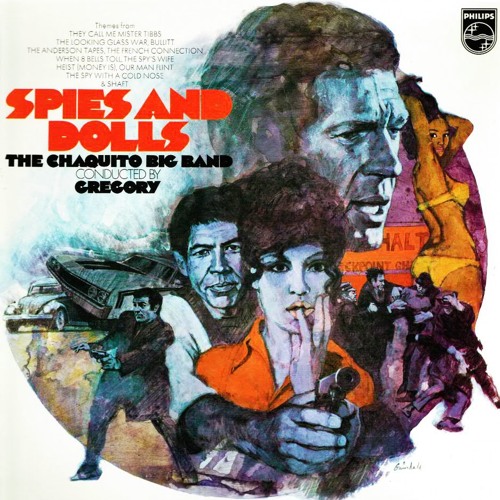
The Chaquito Big Band
Spies And Dolls (1972)
Coming out in 1972, this Bond cash-in from Chaquito Big Band takes full advantage of the musical styles that had become popular by then. Lots of wah-wah guitar, Hammond organs, rapid-fire percussion, and the sort of big brass and strings you were getting in everything from Isaac Hayes to the music from Enter the Dragon to big hit cop TV shows. The Chaquito of the group’s name was British composer Johnny Gregory, who among other accomplishments, led the storied BBC Radio Orchestra for nearly two decades. He came from a musical family, with a father who led a dance band at London’s legendary Italian restaurant, Quaglino’s. Apart from being a hot spot for British aristocracy (including Queen Elizabeth herself, who became the first reigning British monarch to dine at a public restaurant when she dropped by in 1953), Quaglino’s has a few important stamps on its James Bond and espionage history passport. Ian Fleming dined at Quaglino’s with Maud Russell, an American anti-fascist activist and, for a time, Ian’s lover. The two spent dinner arguing over politics, most likely having to do with Ian being at the time, like many upper-class Brits, in favor of appeasement rather than war with up-and-coming dictator Adolf Hitler.
Quaglino’s was also the restaurant that MI5 operative Major Thomas Robertson, who specialized in double agents, chose to influence a potentially important asset: Agent Tricycle, aka Dusan “Dusko” Popov.* Popov would eventually be chaperoned at a Lisbon casino by young Naval Intelligence officer Ian Fleming, who watched with awe as playboy spy Popov used the money given to him by the British government to bankrupt Nazi after Nazi at the gambling tables. Popov’s brash actions made such an impact on Fleming that he eventually used the night as the basis for the plot of his first novel, Casino Royale. Later in life, when asked what it felt like to be one of the primary models upon which Fleming based James Bond, Popov, in a move as cool as 007, brushed it off, claiming (perhaps rightly) that his own life was far more exciting than Bond’s.
Johnny Gregory’s father, Frank Gregori, would likely have been the band leader at Quaglino’s while all of this was going on, and since young Johnny worked in the band for a time as a violinist, it’s even possible he performed for some point for Ian Fleming or Dusko Popov. True to his background in pop, dance bands, and scoring, the Chaquito Big Band’s contribution to the world of Bond cash-ins, is big and bold and very early 1970s. It starts out with a truly blistering rendition of the theme from the Sidney Poitier film They Call Me Mr. Tibbs, followed by a number of other ace arrangements of movie themes, including The Anderson Tapes, The French Connection, Our Man Flint, Bullit, and Shaft. There are also some good original compositions. What there aren’t weirdly, are any James Bond themes. However, don’t let that sour you on this album. Chaquito Big Band delivers a high-energy album that bridges some gaps between the purer John Barry sound of the 1960s and the more groove-oriented sound of the 1970s.
* Want to know more about the wild story of Ian Fleming and Dusko Popov? Well, I just happen to have written a book, Cocktails and Capers, that has a chapter dedicated to the story, with special guest appearances by Mussolini, Lucky Luciano, and a bunch of cocktail recipes.
Count Basie
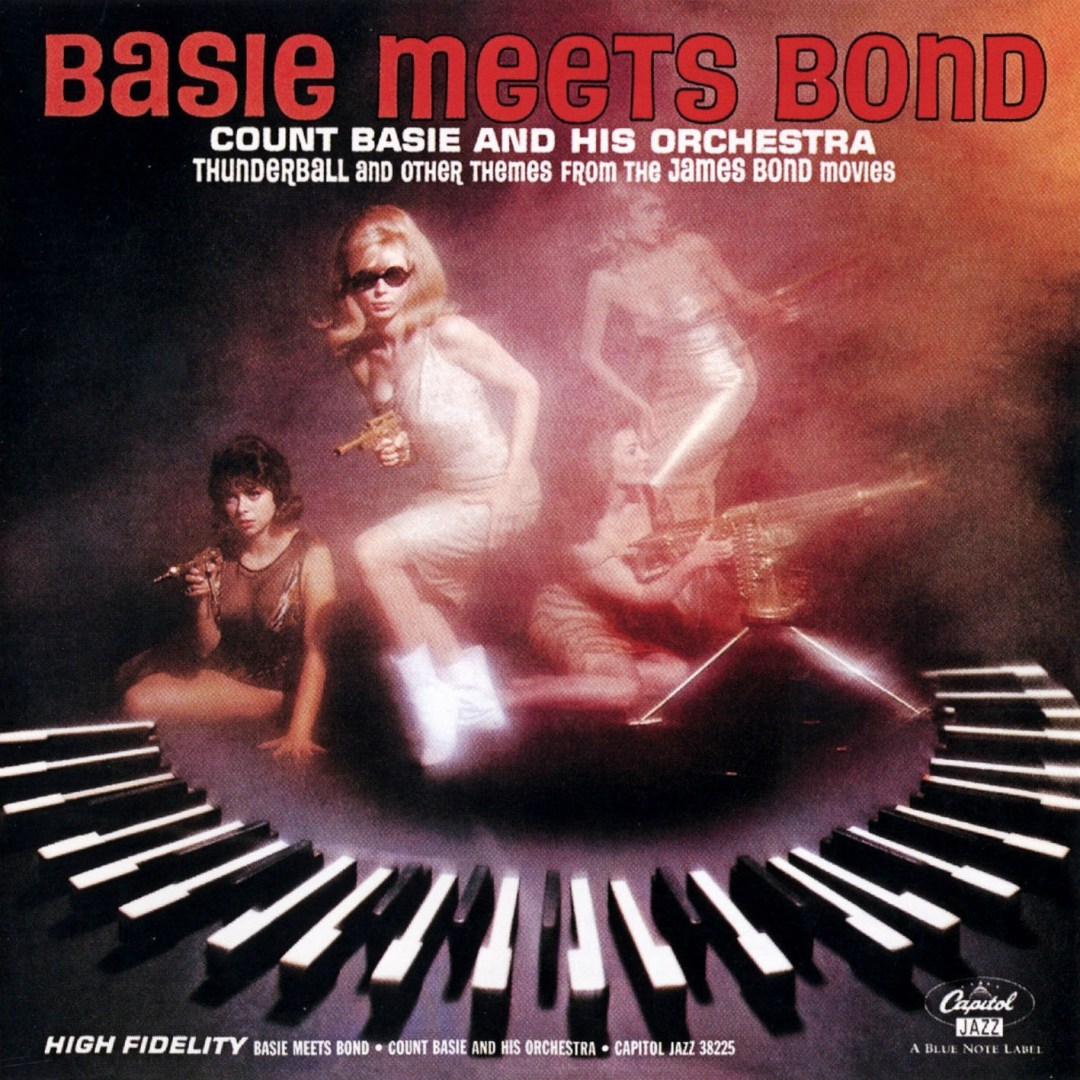
Basie Meets Bond (1966)
While a lot of accomplished musicians recorded albums of James Bond and spy movie music, most of them were big names behind the scenes, as talented arrangers and session musicians. But there’s no bigger name in the field known to the public than jazz pioneer Count Basie, who in 1966 decided to make a few extra dollars by committing his band to dash off some disposable but well-executed spy anthems. Not surprisingly, of all the albums so far featured in these world tours, this is the one that skirts the closest to pure swinging jazz and big band, though it also remains modern and in touch with the John Barry style. Also not surprisingly, it didn’t fall on particularly receptive ears when jazz fans at the time, attracted by Basie’s name, gave the LP a spin and found it mostly to be a skippable cash grab. In subsequent years, it’s been reassessed, and generally gets more complimentary reviews.
Well, cash grab it may have been, but it’s still a pretty great album. The Count draws music from the first four 007 films (Dr. No, From Russia with Love, Goldfinger, Thunderball) and concentrates particularly on music from Dr. No, which gives him an excuse to flex some calypso muscle. In fact, the messy story of the Dr. No soundtrack directly involves Count Basie and a song on Basie Meets Bond, “Dr. No’s Fantasy” (of which the album contains two versions). When Monty Norman, officially the composer for the movie’s soundtrack (the bad blood between he and John Barry, especially over what would become the well-known James Bond theme, was the stuff of multiple lawsuits), was in Jamaica doing research alongside Island Records founder (and eventual owner of Ian Fleming’s Jamaican home, Goldeneye), he met up with Basie.
Norman was struggling to nail the film’s signature theme, and Basie was interested in Norman’s Dr. No music, so Monty sent the Count some of his ideas. What Basie came up with and pitched back to Norman as a possible theme for the movie was “Dr. No’s Fantasy.” In the end, it was judged not “sinister” enough to serve as James Bond’s theme, though a version appears on the re-issued Dr. No Soundtrack and Basie’s two versions appear on Basie Meets Bond.
Given his connection, however tangential, to Dr. No, it’s no surprise that Basie would explore other tracks from that film, including arrangements of “Kingston Calypso” and the movie’s signature tune, “Underneath the Mango Tree.” Monty Norman’s life probably would have been easier if they’d gone with Basie’s proposed theme. Beyond the Dr. No songs, Basie and his band deliver breezy versions of themes from the subsequent three Bond films, as well as the inescapable “007 Theme” and, of course, a swingy, loungy version of the James Bond theme. Is it an essential album for Basie or harder-core jazz fans? I doubt it. But for aficionados of Bond music and some of the more esoteric pieces of James Bond history, Basie Meets Bond is a worthwhile curiosity with some fun, undemanding music with a twisty direct connection to official James Bond music.


Ray Martin and His Orchestra
Goldfinger and Other Music From James Bond Thrillers (1965)
Thunderball and Other Thriller Music (1965)
Ray Martin was an Austrian-British orchestra leader who made a name for himself as a dependable composer of “light” music. Wasting no time (not by choice) in establishing his espionage bona fides, he immigrated to England from Austria in 1938 and was promptly placed under suspicion of being a Nazi spy (even though he was Jewish). He was interned as a prisoner of war and sent to Australia, where he was held until 1941. Upon his release, he apparently bore no ill will toward the new home that had tossed him in a prison camp, because he promptly joined the Army. He worked for six years in British Intelligence and, in his spare time, he was an arranger and composer for the Royal Air Force Band, and he somehow mounted an operation to rescue his brother, who was imprisoned in a concentration camp. If that doesn’t qualify a man to dash off a couple of albums of James Bond and spy movie music, then nothing does.
The first of his two Bond albums, Goldfinger and Other Music From James Bond Thrillers opens with…you guessed it the theme from Goldfinger yet again. However, for a change, this version brings something new to that well-worn territory. Martin’s arrangement nails the brassy John Barry sound, but he gives it a little something extra by adding female vocals either sighing wordlessly or belting occasional lyrics from the original. No Shirley Bassey, these ladies, but they give the song a very mod, pop sensibility. After so many versions of this particular theme, it’s a joy to hear one that makes you take notice.
The ladies stick around for most of the tracks, taking on, among other things, a vocal rendition of the guitar parts in the James Bond theme, which Martin really jazzes up. Because not only did the song need ghostly female vocals, it also needed a sax solo. Similar goosing is done to most of the song, including the theme from From Russia with Love and the one song other than Goldfinger and the Bond theme that might be the most ubiquitous, “007 Theme,” and even that Ray and the gang turn into something new. Every song is infused with go-go boots and miniskirts energy, much poppier than jazzy most of the time but always exciting and unique among Bond cash-ins. It’s one of my favorite of all of these albums.
He brings along the girls, the sax, and the gusto for his second Bond album, Thunderball and Other Thriller Music, anchored by a spectacular, fast-paced version of the Thunderball theme and delving into more non-Bond material, including a breezy arrangement of the theme from The Knack…And How to Get It, a version of “A Man Alone” from The IPCRESS File that could almost fool you into thinking the movie isn’t depressing, and similarly lunatic go-go pop versions of The Man from UNCLE, the Bond track “Mr. Kiss Kiss Bang Bang,” Honey West, and more. Both of these Ray Martin albums are absolute joys. They are just…delirious. Beautifully, energetically delirious, like someone took John Barry, Esquivel, Lulu, Bruno Nicolai, Al Caiola, and a drive down the Amalfi Coast in a convertible MG and threw them all into a blender.
Eric Winstone
Eric Winstone Plays 007 (1973)
My continuing foray into James Bond-inspired albums has turned up some colorful characters with strange and amazing backgrounds, but few are quite as odd and tumultuous as that of pianist/accordionist and big band leader Eric Winstone. Among the highlights of his interesting life is a public feud with 1950s British bombshell Diana Dors and the construction of an iron partition running through his home to separate him from his fashion model wife and child. In between those things and getting a restraining order to prevent his mother-in-law from visiting his home, Winstone managed to record a run-of-the-mill but pretty enjoyable album of James Bond themes. Released in 1973, Eric Winstone Plays 007 was one of the last things he recorded before his death in 1974 at the age of 61.
Winstone was not a prolific recording artist under his own name, sticking primarily to live performance and, later, work with TV and movie music libraries. Winstone was a clerk at the Westminster Gas and Coke Company and played music in his spare time, at least until performances with the company band led to more professional gigs. He opened an accordion school and started two dance bands in the 1930s, Accordion Quintet and Swing Quartet, the last of which frequently featured popular vocalist Julie Dawn (whose father, incidentally, was head waiter at the famed Savoy Hotel; for more on that place and its ties to James Bond and cocktail history, I humbly suggest you check out my book, Cocktails and Capers: Cult Cinema, Cocktails, Crime, & Cool).
Like many British musicians who record Bond albums, he cut his teeth in the Royal Air Force band entertaining troops during and after World War II. Apart from his military performances, he became a staple of the Butlin’s Holiday Camps resorts. It was while playing at one of these camps in the 1950s that Winstone’s feud with Diana Dors was ignited. She had been contracted to perform with Winstone and his orchestra for 15 minutes and could not make the performance, owing to a throat infection. Rather than shrug it off, Winstone complained about her to the audience and, shortly thereafter, filed a lawsuit for breach of contract. Dors, in return, filed a defamation suit against Winstone. When the case went to court, the judge was so astounded about so much noise being made over a gig that paid a pittance he awarded each side a token pittance—£5 to Winstone, and because England is weird, 100 guineas to Dors (about £105). Dors donated her settlement to charity.
By the 1970s, his big band style was both out of style and somehow back in style, at least in that the spirit underpinned a lot of the jazzier covers of pop tunes that were being released on budget LPs at the time. Eric Winstone Plays 007 was an instrumental project put together by Syd Dale, a legend in the world of soundtracks and library music. Dale was a master of the sound that would come to define late-1960s and 1970s British spy and cop shows, largely through recordings for his own Amphonic Music company. Dale combined classical orchestration, jazz funk, and fuzzed-out guitars on many of his arrangements (which are still being used to this day), but he was also a huge fan of big band and swing music (even recording some himself), so it must have been a treat to collaborate with and old hand like Winstone.
Although Winstone and Dale’s version of the James Bond theme has a great, meaty 1970s beat to it without veering into disco, and there’s some solid action from the brass section. The arrangement of “From Russia with Love” is one of the weirder tracks on the album, with a 1970s funk beat keeping time with what is almost Herb Aplert-esque trumpet playing. It’s pretty solid. “Mr. Kiss Kiss Bang Bang” has always been a track to show off a little muscle, although Winstone’s version is a little jazzier than the usual, anchored by some sax work rather than the trumpets one usually hears on the song. “Diamonds Are Forever” gets a slow cocktail jazz treatment, again with hints of Herb Alpert in the mix and some quality vibraphone action lending it that extra lounge mood. The faux-Caribbean style of “Underneath the Mango Tree” is jettisoned entirely in Winstone’s version, which opts for a groovier almost sunshine pop meets swinging London lite sound. You can imagine it being performed on one of those pop music Tv shows with a bunch of young women in go-go boots and miniskirts dancing on platforms of various elevations. Good arrangements of “You Only Live Twice” and “Thunderball” round out the Connery years.
That dancier groove carries over into “The Man with the Golden Gun,” which was already going for a Swinging London in the original film version performed by Lulu. However, given the vintage of Eric Winstone Plays 007, this is an original composition (The Man with the Golden Gun wasn’t released until 1974). The only film theme from the Roger Moore years available to Winstone and Dale was “Live and Let Die,” and they do a pretty cool version of it that, again, cocktail lounges it up a bit. The only other non-Sean Connery film released at the time was On Her Majesty’s Secret Service, starring George Lazenby in his one and only outing as James Bond. So take your pick, Winstone: both the OHMSS theme and “We Have All the Time in the World” are absolute 007 classics that would work perfectly with the overall vibe of this album.
And so they go with…”Do You Know How Christmas Trees Are Made?” Which is certainly…a choice. I admit, it’s never been my favorite piece of James Bond music, and there’s a reason very few of the artists who recorded Bond cover albums chose this one to include. But, points for originality, I reckon. Maybe Syd Dale was influenced by the fact that he was in the middle of recording an album of big band Christmas tunes. Anyway, devoid of the children’s chorus lyrics, this version of “Do You Know How Christmas Trees Are Made” is given a mellow late-night lounge sound that isn’t half bad. Still, it would have been great to hear them tackle one of the two more popular tunes from the movie.
Of course, I’d also love to hear Ray Winstone Plays 007, but I suppose that’s not likely to happen.
James Bond cash-in albums will return in…GOLDSINGER!
 Teleport City