Bollywood remakes The Rundown with a lot more singing, dancing, and one freaky freaky Friday night
For anyone who ever watched Indiana Jones and the Temple of Doom and was disappointed that, for all its over-the-top absurdities, it didn’t feature a scene where Harrison Ford punches a dwarf and makes him fly across a field, then Naksha is the movie for you. Only it’s not Harrison Ford doing the punching; it’s action cinema mainstay Sunny Deol. But hell, if anyone in the world is going to punch a guy of any size and make him fly across a field, then it’s going to be Sunny. Jackie Chan may have tried it at some point, but he’s past the days of being able to do that anymore—although he is an appropriate actor to bring up in our discussion of this movie. Naksha gets compared to Raiders of the Lost Ark (because all adventure films get compared to Raiders), it’s actually a remake of the moderately fun Dwayne Johnson action-adventure film The Rundown. Infused into both Naksha and The Rundown, though, is the DNA of modern-setting adventure films of the late, great Cannon Studios, like Treasure of the Four Crowns or that thing where Chuck Norris and Lou Gossett, Jr. bicker and hunt for gold or whatever
Similarly, Naksha resembles the globe-trotting adventure antics of Hong Kong adventure films like Jackie Chan’s two superb Armor of God films and Michelle Yeoh’s entertaining but awful The Touch. Naksha is the tale of two brothers and a tag-along woman who doesn’t do much (shocking) who traverse a mountainous jungle wilderness in search of a secret temple and a sacred relic that could turn villain Jackie Shroff into an invincible superman, instead of turning him into the twin of French actor Jean Reno, which seems to be nature’s own plan for Shroff.
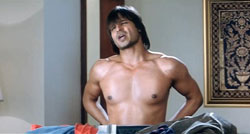
Pretty boy Viveik Oberoi stars as Vicky, a fun-loving goofball who likes to spend his night at sexy dance clubs where the singers implore you to “shake what your momma gave you.” While hosting a bachelor party for his pal, Vicky meets dancer Riya (Sameera Reddy), who chastises him for being a low–down dirty dog, and that’s pretty much that. But when Vicky learns that his father, a famed archaeologist who died mysteriously some years before, may have been murdered while trying to protect a map to a sacred relic, he suddenly kicks himself into intrepid adventurer mode and sets out to find the lost relic — which happens to be the armor and earrings worn by Karna during his legendary battle with Arjun, as described in the Hindu book The Mahabharata (which is a religious book in much the same way The Old Testament or The Iliad are: presumably historical events are mixed with or attributed to the intervention of gods and the supernatural). Whoever dons the armor and earrings will be rendered invincible.
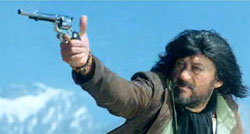
Also searching for the armor is the dastardly Bali Bhaiyya, played by Bollywood veteran Jackie Shroff. Bhaiyya has no real back story other than the fact that he’s the one who is responsible for the death of Vicky’s dad. Exactly who Bhaiyya is, we never really find out, but adventure movies always have a villainous guy looking for the same treasure. In Raiders it was Belloq, in The Touch it was Count Dracula himself, Richard Roxburgh. And here it’s Jackie Shroff. They’re all pretty much the same: possessed of seemingly unlimited wealth (while the hero always seems to be rougher around the edges) and an unlimited number of incompetent but well-armed henchmen in black t-shirts or trench coats. Said henchmen quickly pick up Vicky’s trail, and although he proves himself an able enough fighter, he is soon overpowered and strung up in a vacant building, about to be eviscerated by Bhaiyya’s goons.

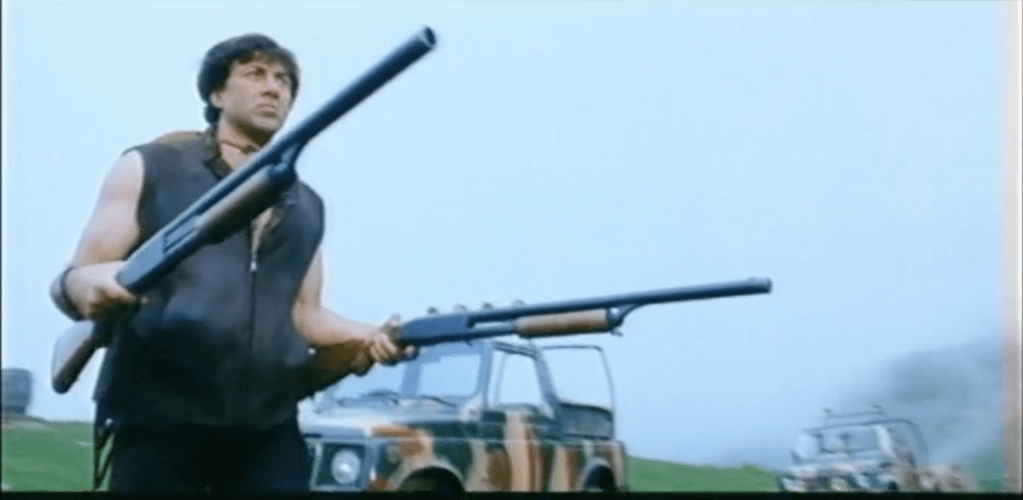
Until, that is, Sunny Deol crashes through the ceiling in slow motion and starts blowing fools away and punching them across the room.
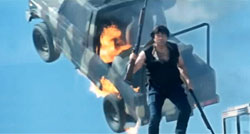
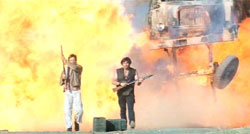
Up until this point, the film has been pretty so-so, with a typical adventure film “discovering the plot” build-up and a lead who was neither good nor bad, but simply a null value that wasn’t going to engage me for the full film. But as soon as Sunny comes smashing through the building like The Incredible Hulk, wearing his old school Banana Republic safari hat, well that’s when the movie actually begins. From there on out, there’s a few minutes sprinkled here and there dedicated to our main cast bickering with each other or pausing for a musical number, but for the most part it’s all Sunny beating the crap out of people and walking in slow motion as shit blows up around him.
Sunny plays Veer, Vicky’s long-lost brother. It turns out that when Vicky called his mom to tell her where he was, she in turn called Veer and asked him to bring Vicky home. So Veer then used his incredible powers of teleportation to get to the remote little village where Vicky was being held captive, then used his incredible powers of ESP (or possible Google Maps) to locate the exact building in which Vicky was being held. Forget Karna’s magic armor. Veer already seems possessed of near godlike omnipotence. Plus he can smash through buildings and punch guys so hard they fly across the room.
Vicky properly saved, Veer goes about the task of trying to bring the rascally younger brother home, which proves difficult, as Vicky is nothing if not sneaky. Things get further complicated when, in the middle of the goddamned jungle far from home, the two brothers run into Riya, trapped in an out-of-control raft in a raging river. Apparently, she went on holiday and booked a white water adventure with an outfitter who takes women in their regular street clothes and plops them into a novelty-grade raft and sets them out into class IV rapids without partners or guides.
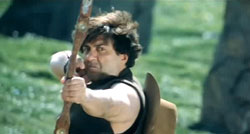
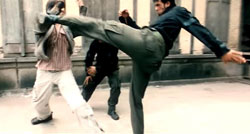
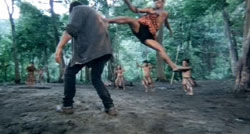
The movie spends a little too much time with the trio monkeying about in the jungle (though sadly, and surprisingly, there are no hijinks or comedy bits involving actual monkeys), but that’s forgivable as soon as Bhaiyya and his goons catch up and we get a parade of exploding trucks, kung fu fights, shotguns that seem to fire atomic bombs, and a scene in which the heroes run afoul of a jungle tribe that whip out some serious kungfu skills on Sunny (in a scene lifted wholesale from The Rundown, even going so far as to hire an Ernie Reyes Jr. look-alike for the fight) before everyone makes up and gets drunk and dances through the village. And on the village. I don’t know how happy the tribe was to have a big lug like Sunny Deol dancing on their roofs. I mean, if he can smash through the roof of full-size building, who knows what kind of damage he could do to the mud and grass hut of a guy named Liliput.
Eventually, everyone gets back to the business of trying to recover Karna’s artifacts, leading to a big showdown in the hidden mountain temple, which is of course stuffed to the gills with booby traps (most of which are stolen from Indiana Jones and the Last Crusade) and candles that light themselves.
Naksha is a pretty dumb movie, but that doesn’t mean that I didn’t like it. I liked it a lot. But then, keep in mind that I like pretty much all adventure movies, even those Tomb Raider movies no one else liked (in fact, I loved those), and even Treasure of the Four Crowns. Naksha is better than Treasure of the Four Crowns, and better than The Touch. It’s about on equal ground with the film it rips off, The Rundown, but it’s still no Raiders of the Lost Ark. Granted, nothing is (not even the other Indiana Jones films), so it’s not really all that fair or useful to say a movie isn’t as good as Raiders. Still, measured against the rest of the world’s adventure films (including those Antonio Margheriti adventure films starring David Warbeck), Naksha measures up pretty well. At this point in the history of adventure films, however, I’m used to just looking the other way when a woman from earlier in the movie shows up at random in a raft on a river in the middle of a remote jungle. Or when Sunny Deol travels at the speed of light to the location where his little brother is being tortured. Or the fact that everyone solves all the treasure map’s clues by sort of staring off into the distance until “revelation music with chanting in it” plays and gives them the answer to the puzzle.
But there’s a word for watching a guy sit for ten years trying to decipher clues on an esoteric map, and that word is “archeology.” And since real archaeologists rarely get in kungfu fights or get involved in magical battles in secret temples, let’s leave them to their work at the Museum of Natural History, and let’s let adventure films be populated by guys like Sunny Deol blowing up trucks and swinging around sawed-off shotguns.

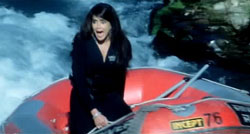
You may notice that, while Viveik Oberoi is ostensibly the hero of this movie, I’ve barely mentioned him. That’s because he’s not even there. Not really. There’s a reason Ajay Devgan is the guy everyone remembers from Company, even though Viveik was the main character, and there’s a reason we’re talking about Sunny a lot more in Naksha. Oberoi doesn’t really strike me as a bad actor; it’s just that he spends pretty much the entire movie mugging for the camera and going over-the-top in a way that makes him less like the hero and more like the hero’s odious comic relief sidekick. This leaves the actual hero work squarely on the beefy shoulders of workhorse Sunny Deol, where it belongs.
Sunny is getting on in years by the time of Naksha, but I still have no problem buying him as an action hero. I also have no problem at all buying Sunny as a legitimate tough guy. The trend these days is to feature uber-scultped male model types as action heroes (case in point: Viveik Oberoi). Sure the bodies look good in a gym, but do any of these lads strike you as someone you’d want to depend on in a fight? I’d be much happier knowing that a guy like Sunny Deol, with his tree trunk arms and a little bit of fat, has my back. When Viveik Oberoi punches someone, you sort of shrug and go, “Eh, it’s a movie.” But when Sunny punches someone, you believe that someone would fly across the room and through a wall.
The other person to pay attention to in this film is Jackie Shroff. Again, we see that while Viveik may have been seen as the handsome, young lead, this movie really belongs to the veterans. Where as Oberoi’s over-the-top mugging comes off as lame, Shroff gets to go just as over-the-top as the villain of the piece, but he executes his scenery-chewing turn with ace perfection. As I mentioned earlier, he is almost totally devoid of character. He is evil because the movie says he is evil, and because he is willing to gun down a village full of kungfu dwarves. But beyond that, the movie pretty much relies on you recognizing a well established adventure film archetype.
And honestly, is his sinister plan really worth all this effort to prevent? The armor may make you invincible, but I still bet it would be pretty hard for one guy wearing heavy armor to conquer the entire world. I guess these villains never really expect to succeed in their mad schemes, so they don’t think through the actual logistics of their proposed global conquest. But whatever the short-comings of his plan may be, Jackie still gives his all despite being in such a goofy movie. You could jettison Oberoi and Sameera Reddy from this film entirely and just leave the whole thing up to Deol and Shroff, and you’d probably be better off for it.
Speaking of which, I almost forgot Sameera Reddy was in this movie. Naksha gives her absolutely no purpose other than to be the pretty girl and get captured every now and again by Shroff’s goons. Her turn isn’t really bad—we’re not talking Kate Capshaw here—but there’s certainly nothing to it. Even in a film with precious little substance anywhere, she seems dashed off. So at least she’s no Kate Capshaw, but she’s also no Karen Allen. She looks good in the musical numbers though, and I guess that’s about all she’s supposed to do.
Plotwise, you can pretty much guess that this movie isn’t exactly coherent. Coincidences abound, things happen for no reason, and people just seem to appear in places with very little effort or explanation, sort of like how Tony Jaa was always able to teleport to wherever he thought someone would be who might know where his elephants were in Tom Yung Goong. Within the realm of adventure films, the plot is actually better—or at least more sensical—than many, but that’s really not saying a lot. The plot isn’t really the point here, though. The armor is just a MacGuffin that allows the movie to indulge in a parade of exploding trucks, shotgun battles, and kungfu fights.
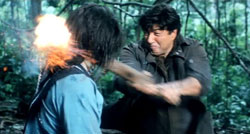
And in this capacity, Naksha delivers the goods in excess. Really in excess. No truck explodes when five trucks could explode instead. And nothing just explodes when it could explode and shoot end over end, fifty feet up into the air. And no one gets punched and falls down when they could get punched and fly like a hundred feet back and through a wall or a tree or a windshield. The action is way over-the-top, well into the realm of the cartoonish, but it’s still great good fun. It does make for a weird transition when the wacky action has serious consequences, but awkward shifts in tone are hardly the sole property of Naksha.
I’ve brought up both Armor of God and The Touch in this review, which probably doesn’t mean a whole lot to people haven’t seen either of those films. First of all, if you haven’t seen Armor of God yet, you should. The bad slapstick comedy is more than made up for when Jackie starts kicking people so hard it makes them flip over backwards, hit their shins on the edge of a wooden table, then flip over backwards again before hitting the ground (you really just need to see it). It’s the second most painful looking abuse Jackie has visited upon a stuntman (the first being in Police Story, when he kicks that dude on the escalator and makes him flip backward and land chest first on the edge of the metal stairs and then he bounces . Again, you have to see it to understand just how painful it looks).

As for The Touch—not so much. It’s really pretty bad, even though I still watch it from time to time just because I like adventure movies, and the cinematography is nice to look at, and Michelle Yeoh is a peach. Naksha resembles The Touch in that it takes the traditional adventure film and attempts to graft some sort of cultural-religious context onto the action. In the case of The Touch, it was Buddhism, and obviously here it’s Hinduism. However, I’d say the lessons in Hinduism (taught to us in cartoon format!) to be taught by Naksha are about as trustworthy as the American history taught to us by National Treasure, so I wouldn’t use this movie in place of reading the actual historical texts. Actually, I would. But you shouldn’t.
It’s this, and the supernatural ending, that makes Naksha feel like The Touch, though I would qualify that statement by saying that Naksha is a much more enjoyable movie. Director Sachin Bajaj finds himself in that position for the first time, and even though it looks like he got the job through the ancient tradition of nepotism (his father is a film distributor in India and is listed as the producer of Naksha), Bajaj handles the job well. Not perfectly, but well. The pacing is OK, there’s a little too much reliance on slow-motion during action scenes, and the cinematography (by Vijay Arora, who does have a lot of experience in the field) nicely captures the landscapes and contributes the exotic feel that is so important to a successful adventure film. Incidentally, The Touch was directed by a cinematographer-turned-director too, and while that film is frequently gorgeous, it’s rarely good. If Bajaj was still a novice director, he at least had the good sense to surround him with a capable crew.
There’s also a fair number of special effects which, for the most part, are realized pretty well. Not everything is pulled off perfectly, but if I were to assume the budget to be roughly the same or slightly lower than The Touch, the effects in Naksha pretty much blow that film out of the water. That said, the CG in The Touch was pretty awful, and Naksha doesn’t even deserve to be dragged down to that level by an act of comparison. There are also a fair number of practical effects, as well as the kung fu fights. India, like pretty much the rest of the world, has never quite gotten the knack of filming a superb kung fu fight the way they can (or could) in Hong Kong. So there’s no kungfu showdown of the quality we get at the end of Armor of God when Jackie takes on an entire monastery full of evil monks and a gang of leather-clad, high-heel wearing kung fu amazons (Jackie was just making some weird nonsense up with that one, wasn’t he?).
That said, I wouldn’t really expect to see someone with Sunny Deol’s build going all 1980s Jackie Chan in a movie. Deol is a classic tough guy, and his job is to move slower but with thunderous power. The fight choreography in Naksha is OK, maybe slightly above average if you average out the quality of fight scenes all over the world. It does rely a lot on the gravity defying wirework that is so en vogue and has been so since the 90s in Hong Kong. But since the fight scenes are, for the most part, possessed of a cartoonish over-the-top quality anyway, the wirework doesn’t detract. And Sunny still looks solid just punching or kicking guys square in the jaw. I guess Viveik Oberoi gets in some action, too, but honestly, is he still even in this movie?
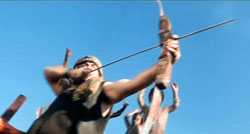
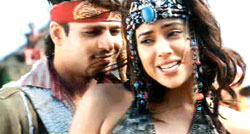
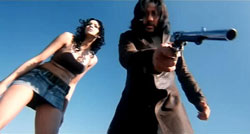
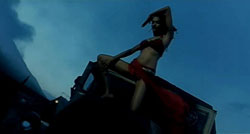
The score is pretty much the de rigueur “faux tribal” orchestration so common to modern adventure films, with lots of enthusiastic “Ho! Whoa-ah ho!” chanting and percussion punctuated by flutes and that “haunting moaning” for moments of introspection and revelation. If you’ve seen an adventure film in the last thirty years, you pretty much know the score. The song where they party with the tribe is OK as it’s just an extension of the score, and sounds like one of those “tribal music written by white guy” songs you hear on Globe Trekker. Then there’s the “Shake what your momma gave you song” and the “freaky freaky Friday night” song—there’s a reason neither of these set the pop charts ablaze (as far as I can tell). The other song is performed when Jackie Shroff’s standard issue “sexy, evil mercenary woman in booty shorts” performs a number for the goons, but honestly, I can’t even remember how that sounds now, because all I can think about is that horrible “freaky freaky Friday night” song. Or…wait. Is it horrible? Because it’s been stuck in my head for days. Oh my god. Do I like “Freaky Freaky Friday Night?” Do I…love it???
However well Deol might acquit himself in the action scenes, and however charismatic and likable a performer may be, one thing that does astound me about the man is that, after decades as a leading man, the guy still hadn’t learned to dance by the time of Naksha. There are just a few musical numbers, and Deol is involved in only two of them. And one of those isn’t even in the movie. It’s just a music video tacked on to the credits. And it’s here that Deol’s proficiency for the dancing rears its ugly head. The other musical number in which he’s involved is the drunken revelry with the tribe of kung fu dwarves, and his job there is mostly to drink, smash some clay pots, and stomp around like a joyous madman. That he can do.
But that final musical number pasted into the closing credits calls for actual dancing, and while Viveik and Sammera wriggle and writhe about with skill, Deol dances with all the grace, rhythm, and timing of Boris Karloff as Frankenstein’s monster. I don’t know how you stick around in Bollywood as long as Sunny has without learning how to dance, but somehow he managed. Still, when you think about it, if you have an action-packed kungfu adventure movie full of lost treasure, secret maps, and exploding trucks, do you want your hero to look good in the post-adventure dance number, or do you want him to look good kicking ass in the rest of the movie? Let Viveik and Sameera have their paltry moment to shine in the “freaky freaky Friday night” closing credit song, because Deol owns the rest of the film. The director must have also realized that dropping Deol into the middle of a bunch of dancers for a music video was a bad idea, because eventually, he stops making Sunny try to dance and just lets him lounge about surrounded by writhing women.
Both Oberoi and Deol were in a bit of a slump when they starred in this film, and Naksha didn’t do a whole lot to revive them. Naksha had a big budget, and adventure/treasure hunt films of this nature are pretty scarce in the overall cinematic landscape of Indian cinema. I guess Bajaj was hoping the stars and the relative uniqueness of the genre would translate into box office success. No dice, though it was a fun effort despite the box office failure and mixed reviews in India, ranging from “dumb fun” to “mindless idiocy and harbinger of the end of Indian cinema.” The film did well in large cities but tanked everywhere else. Since most of India is everywhere else, you can’t really get by without everywhere else. Does a film like this represent a rift between urban areas, where perhaps people are more open to change, and rural areas, where something not identified as traditional is met with suspicion and hostility? If so, once again this is hardly a situation unique to India, but it does spotlight one of the great problems we face as our world becomes more connected and the varied cultures of the world continue to collide and meld into something new. It seems the more some people want to move ahead into this new arena, the more other people want to pull away from it. And both sides of this tug-of-war have plenty that justifies their position.
Some felt that Naksha wasn’t “Indian” enough, or more accurately, that it was too Hollywood. Perhaps they should watch the Sunny Deol film Indian. I mean, how much more Indian can you get than to call your film Indian? This is a criticism that has been leveled at a lot of cinema these days, from Hong Kong to Korea to France (could Sachin Bajaj become the Luc Besson of India??? I mean, I already cracked that Jackie Shroff looks like Jean Reno, so this is the next logical step), and personally, it doesn’t fly with me.
We are no longer in an era of localized, regional cinema. The cinema of one country has always influenced the cinema of another. Even if the audience wasn’t aware, the filmmakers certainly were. Italian spectacle films of the silent era influenced American filmmakers, who set out to incorporate the larger-than-life opulence into their own films. And then the Technicolor spectacles of Hollywood during the 50s in turn revived spectacle filmmaking in Italy during the 1960s. Westerns became spaghetti westerns which in turn were heavily influenced by Japanese samurai films. And now, Hong Kong action films of the 1980s and ’90s heavily influence American films, which in turn influence Hong Kong films. Thanks to the interconnectivity of the internet, fans and even casual filmgoers are more aware of this global exchange than ever before. When I first started watching Hong Kong action films, I never would have dreamed I’d hear my parents speak with familiarity about Chow Yun-fat or Michelle Yeoh. So yes, Naksha has some very Hollywood elements. It also has some very Indian elements, as well as elements of Hong Kong cinema and Luc Besson’s crop of French action films that have destroyed French film the same way Naksha destroyed Indian cinema.
A review of a goofy, fun-loving flick like Naksha is hardly the best place for contemplation on the globalization and cross-pollination of culture, art, and entertainment, and this is certainly not meant as a defense of Naksha’s sundry faults. It’s hard to argue against anyone who claims this movie is stupid, because Naksha is pretty stupid. And that alone is enough to legitimately dismiss it as bad for many people. I happen to have a different standard though, and the movie was OK in my book. But what we’re talking about here is not whether the film is good or bad, but whether it is too foreign or not, and whether such arguments have much meaning anymore.
Despite the obvious script gaffs and Oberoi’s mugging, Naksha holds up pretty well against the rest of the pack. Depending on how dumb you think the rest of the pack is, you may enjoy this film a lot less than I did. It’s got a playful sense of adventure, decent pacing, some fun fights, nice locations, solid veterans in Shroff and Deol, an appropriately supernatural blow-out for the finale, and lots of people tearing about in Land Rovers. Theater audiences may have met the film with a resounding, “meh,” if they even took the time to do that, but I have to say, I had fun. Plus you know: kungfu fight between Sunny Deol and a guy who was like four feet tall.
Crap. I think I do love the “freaky freaky Friday night” song.
 Teleport City